Subnet / CIDR Calculator
Enter an IP and CIDR prefix to get network address, broadcast address, usable range and host count · free, no signup
How Subnet / CIDR Calculator works, step by step
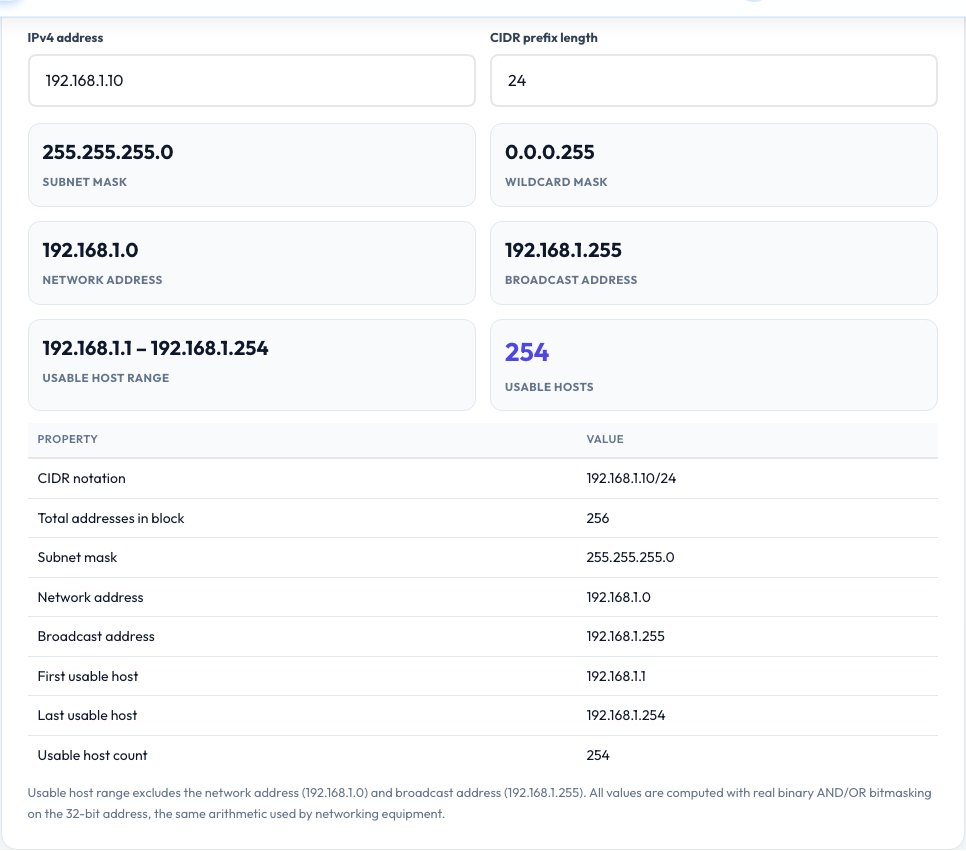
Enter an IPv4 address, e.g. 192.168.1.10.
 Download it
Enter or choose the CIDR prefix length, e.g. /24.
Free Subnet / CIDR Calculator
Enter any IPv4 address together with a CIDR prefix length (the /24 in 192.168.1.0/24) and this tool instantly computes everything that address block implies: the subnet mask in dotted-decimal form, the wildcard mask, the network address, the broadcast address, the first and last usable host addresses, and the total number of usable hosts in that subnet — all done with real binary bitmasking, not a lookup table.
This is the exact arithmetic a network engineer does by hand when planning IP address ranges, configuring a router or firewall, or troubleshooting why a device can't reach another one on the same network. Change the prefix length and watch every value update instantly, which makes it easy to compare how /24 versus /26 versus /28 actually divides up an address space.
Key features
Real binary subnet math
Computes network, broadcast and usable range from actual bitwise AND/OR operations on the address.
Every prefix length, /0 to /32
Works for any CIDR notation, not just the common /24.
Host count and usable range
Shows exactly how many devices can live on the subnet and their first/last addresses.
Wildcard mask included
The inverse mask used in ACLs and OSPF configuration, shown alongside the standard subnet mask.
How to use it
- Enter an IPv4 address, e.g. 192.168.1.10.
- Enter or choose the CIDR prefix length, e.g. /24.
- Read the subnet mask, network address, broadcast address and usable host range.
- Change the prefix to see how the range changes instantly.
Worked example
Example
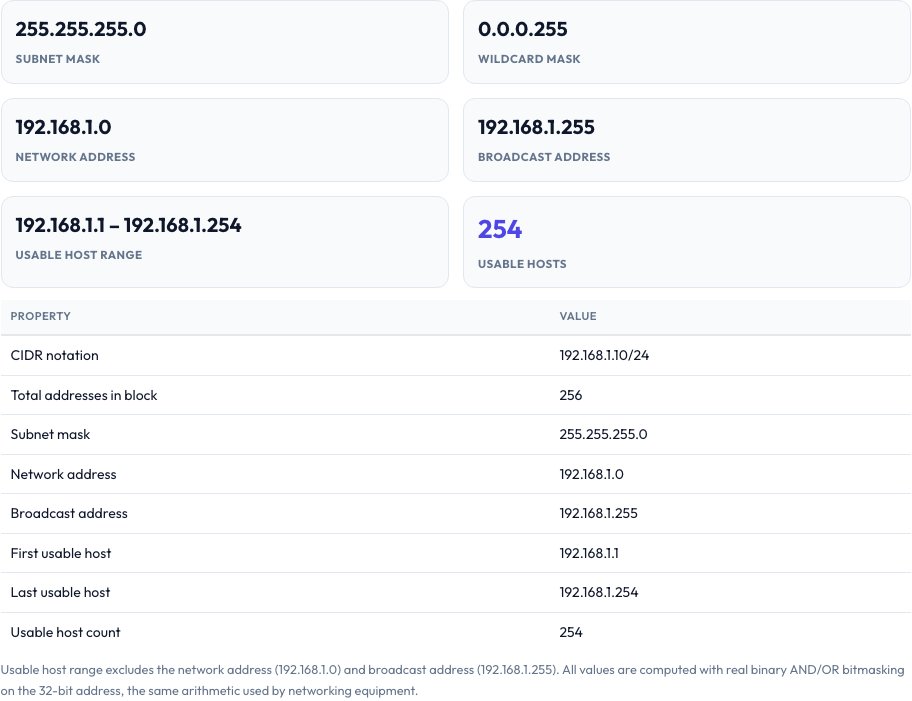
192.168.1.10/24 -> subnet mask 255.255.255.0, network address 192.168.1.0, broadcast address 192.168.1.255, usable hosts 192.168.1.1 - 192.168.1.254 (254 usable addresses).
Who uses this tool
Network and system administrators
Plan IP address ranges and verify subnet boundaries before configuring devices.
Students studying networking or CCNA material
Check subnetting homework and build real intuition for CIDR math.
Developers setting up cloud VPCs
Work out how a /26 or /28 subnet divides within a larger /16 or /24 VPC block.
Tips for the best results
- A /31 subnet is a real special case with exactly 2 usable addresses and no separate broadcast address — used for point-to-point links.
- A /32 is a single host route with exactly 1 address.
- Remember the network and broadcast addresses themselves are not usable by a host — that's why usable host count is 2 less than the block's total size for most prefixes.
- Double check your prefix length matches what your router or cloud provider actually assigned — a mismatch is one of the most common causes of "can't reach this device" issues.
Common mistakes to avoid
- Assuming every subnet loses exactly 2 addresses to network/broadcast — /31 and /32 are real exceptions with different rules.
- Confusing the subnet mask (255.255.255.0) with the CIDR prefix (/24) — they represent the same thing in two different notations.
- Forgetting that changing the prefix length changes where the network boundary falls, not just how many hosts fit — a /25 split of a /24 creates two entirely separate network addresses.
Why use AZRS QuickFix?
It is 100% free, needs no signup and has no watermark or usage limits. The tool runs in your browser, so what you type stays on your device, and it works on phones, tablets and desktops. New tools are added every week — bookmark this page or browse the full QuickFix toolbox.
Frequently asked questions
What does /24 mean?
It means the first 24 bits of the 32-bit IPv4 address are the fixed network portion, leaving 8 bits (256 addresses, 254 usable) for hosts — equivalent to a 255.255.255.0 subnet mask.
How many usable hosts does a subnet have?
Usually 2^(32-prefix) minus 2 (for the network and broadcast addresses), except /31 (2 usable, no broadcast) and /32 (1 usable, a single host).
What is a wildcard mask?
The bitwise inverse of the subnet mask, used in access control lists and some routing protocol configuration — this tool shows it alongside the standard mask.
What is the difference between the network address and the first usable address?
The network address (e.g. 192.168.1.0) identifies the subnet itself and can't be assigned to a device; the first usable address (192.168.1.1) is the lowest address a device can actually use.
Does this work for IPv6?
No, this calculator is IPv4-specific; IPv6 subnetting uses a different, much larger address space and different conventions.
Is my IP address sent anywhere?
No, everything is computed locally in your browser with plain arithmetic — nothing is looked up or transmitted.