Anchor Text Ratio Analyzer
Check Your Backlink Anchor Text Distribution
Analyze your anchor text ratios to ensure a natural link profile. See branded vs exact match vs generic anchor percentages for better SEO.
Anchor Text Analysis
Why Check Anchor Text Ratios?
Natural anchor text distribution is crucial for avoiding penalties and maintaining a healthy backlink profile.
Branded Anchors
Should be 40-60% of your profile. Your brand name as anchor text looks natural and builds brand recognition.
Exact Match
Keep under 5-10%. Too many exact match keywords can trigger Google penalties for over-optimization.
Partial Match
Should be 15-25%. Contains your keyword plus other words. More natural than exact match.
Generic Anchors
Should be 20-30%. "Click here", "read more", "this page" - very natural and safe.
Naked URLs
Should be 5-15%. Raw URLs like "example.com" appear naturally in citations and references.
Avoid Penalties
Unnatural anchor distribution can trigger Google's Penguin algorithm. Keep it balanced!
Understanding Anchor Text Ratios
Anchor text is the clickable text in a hyperlink. The distribution of anchor types in your backlink profile signals to Google whether your links are natural or manipulated.
The 5 Types of Anchor Text
- Branded: Your brand/company name (e.g., "Nike", "Amazon")
- Exact Match: Exact keyword you're targeting (e.g., "running shoes")
- Partial Match: Keyword + other words (e.g., "best running shoes for men")
- Generic: Generic phrases (e.g., "click here", "read more", "this site")
- Naked URL: Raw URL (e.g., "example.com", "https://example.com")
Ideal Anchor Text Distribution
- Branded: 40-60% (most important)
- Generic: 20-30% (very safe)
- Partial Match: 15-25% (natural)
- Naked URL: 5-15% (citations)
- Exact Match: 5-10% (use sparingly!)
Red Flags to Avoid
1. Too Many Exact Match: Over 15% exact match anchors screams manipulation and can trigger penalties.
2. No Branded Anchors: Less than 30% branded anchors looks unnatural for established brands.
3. No Variation: All anchors using the same text is an obvious red flag.
4. All Money Keywords: Every anchor being a keyword you want to rank for = penalty risk.
How to Fix Bad Anchor Distribution
1. Build More Branded Links: Get PR mentions, guest posts using your brand name, and brand citations.
2. Diversify Anchor Text: Use variations, long-tail keywords, and natural phrases.
3. Disavow Spammy Links: Use Google's disavow tool for manipulative exact match anchors.
4. Focus on Quality: One natural link from a quality site beats 100 over-optimized anchors.
How to Use This Tool Effectively
Actionable SEO advice to get the most out of every analysis
Start With Your Competitors
Run your top 3 competitors through this tool first. Understanding their structure, keywords, and technical issues reveals exactly where you can outrank them.
Run Monthly Audits
SEO is not a one-time task. Schedule monthly checks to catch new issues before Google penalizes them. Consistent analysis beats one big yearly audit every time.
Fix High-Impact Issues First
Not all errors are equal. Prioritize: broken crawl paths → missing meta titles → slow load times → thin content. This order maximizes ranking gains per hour spent.
Internal Links Are Free PageRank
Every internal link passes authority between your pages. Use the Internal Link Finder to ensure your most important pages receive the most internal links.
Page Speed Directly Affects Rankings
Google's Core Web Vitals are a confirmed ranking factor. Pages loading under 2.5 seconds see significantly higher rankings and 40% lower bounce rates than slow pages.
Keep Your Sitemap Clean
Your sitemap tells Google what to index. Remove redirect chains, 404s, and noindex pages from it. A clean sitemap = faster, more complete indexation of good content.
More Free SEO Tools
Everything you need to dominate search rankings — all free, no signup required
🔍 SEO & Website Analysis
🧮 Free Calculators
⚙️ Developer & Utility Tools
See Anchor Text Ratio Analyzer in action
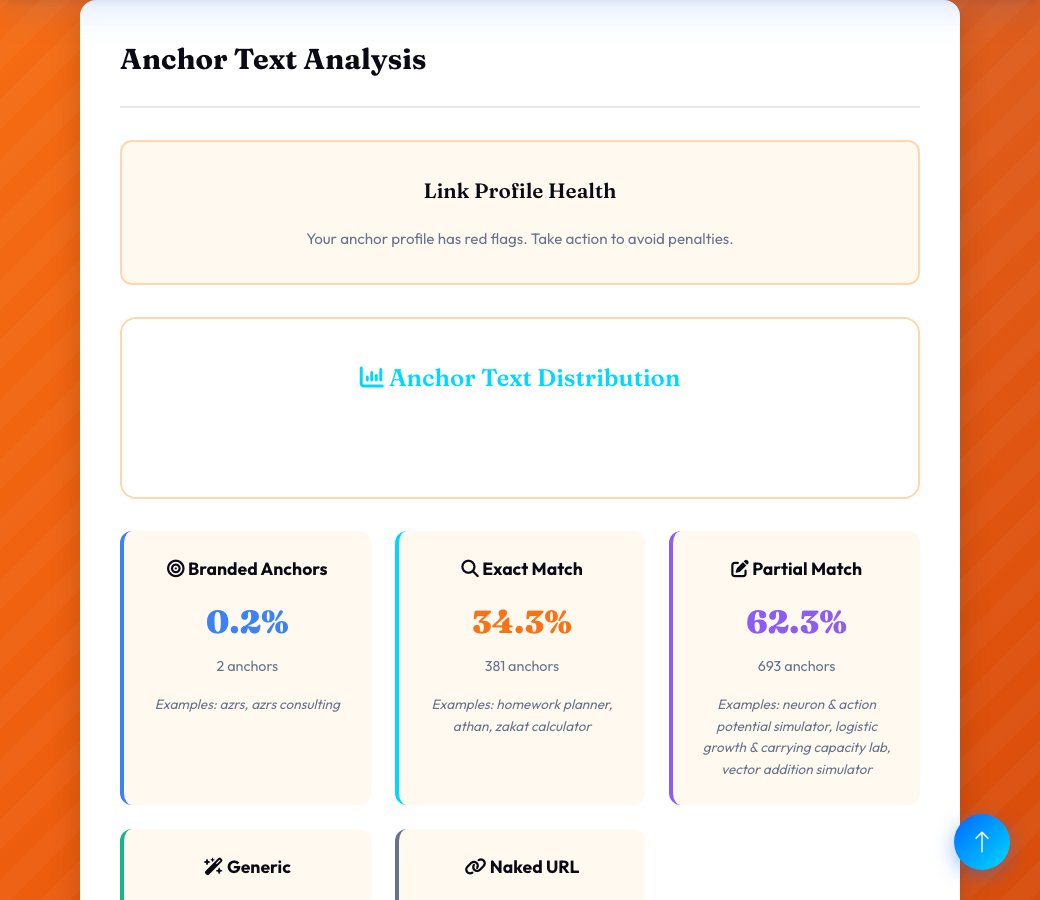
Anchor Text Ratio Analyzer
Enter a URL and this tool crawls the page, collects every anchor text used in the links it finds, and categorizes them into branded, exact-match, partial-match, generic and naked-URL buckets, then shows you the percentage breakdown — a real, on-page anchor text audit of the links actually present on that page.
This is an on-page anchor text check: it analyzes the anchor text used in the links found on the URL you enter, which is useful for auditing your own internal linking patterns and any outbound links on the page — it does not query an external backlink index, so treat it as a health check of the anchors on the page itself rather than a full external backlink-profile report.
Key features
Real anchor text extraction
Pulls actual anchor text from every link found on the page you enter, not a simulated sample.
Five-way categorization
Sorts anchors into branded, exact match, partial match, generic and naked URL buckets automatically.
Percentage distribution
See the real ratio at a glance, with example anchors for each category.
Health status & recommendations
Get a plain-language read on whether the distribution looks natural or over-optimized, with specific fixes.
How to use it
- Enter the URL you want to analyze.
- Run the check and let it crawl the page and collect anchor text.
- Review the category breakdown and percentages.
- Compare against a healthy distribution and adjust future link/anchor text choices accordingly.
Worked example
Example
Analyzing a page finds 62% branded anchors, 24% generic ('click here', 'read more'), 9% naked URLs and only 5% exact-match — a distribution flagged as healthy and natural rather than over-optimized.Who uses this tool
SEO specialists auditing internal linking
Check whether a page's internal anchor text leans too heavily on exact-match keywords.
Content teams reviewing older pages
See if old articles rely too much on generic 'click here' anchors that waste a linking opportunity.
Site owners checking for over-optimization risk
Confirm anchor text patterns look natural rather than keyword-stuffed before it becomes a ranking risk.
Tips for the best results
- Aim for mostly branded and generic anchors with only a small share of exact-match — a natural mix reads better to both users and search engines.
- Keep exact-match anchor text under roughly 5% of the total to avoid over-optimization risk.
- Replace vague 'click here' or 'read more' anchors with slightly more descriptive text where it fits naturally.
- Re-check important pages periodically as new links get added over time.
Common mistakes to avoid
- Over-using exact-match keyword anchors, which can look manipulative and trigger over-optimization scrutiny.
- Using only generic anchors like 'click here' everywhere, which wastes a real opportunity to signal page topic.
- Assuming this reflects your full external backlink profile — it analyzes anchors on the page you enter, not an external backlink index.
Why use AZRS QuickFix?
It is 100% free, needs no signup and has no watermark or usage limits. The tool runs in your browser, so what you type stays on your device, and it works on phones, tablets and desktops. New tools are added every week — bookmark this page or browse the full QuickFix toolbox.
Frequently asked questions
What counts as branded vs generic vs exact-match anchor text?
Branded uses your brand/site name, exact-match uses your target keyword phrase verbatim, generic is vague text like 'click here' or 'read more', partial-match includes part of a keyword, and naked URL is the raw link text itself.
What's a healthy anchor text ratio?
A natural profile is typically mostly branded (40-60%) and generic (20-30%) anchors, with naked URLs making up a reasonable share and exact-match kept low, roughly under 5%, to avoid an over-optimized look.
Does this analyze my backlinks from other websites?
No — it crawls and analyzes the anchor text used in links found on the URL you enter, which is an on-page audit, not an external backlink-index lookup.
Why does anchor text matter for SEO?
Search engines use anchor text as a relevance signal; a heavily over-optimized exact-match pattern can look unnatural and has historically been associated with algorithmic penalties.
What if the page has very few links?
With very few or no links found, results may be limited or fall back to example data — try a page with more real content links for a fuller picture.
Is this free?
Yes, free with no signup required.