Recipe Unit Converter & Scaler
Convert cups, grams and ounces, and scale a recipe up or down · free, no signup
See Recipe Unit Converter & Scaler in action
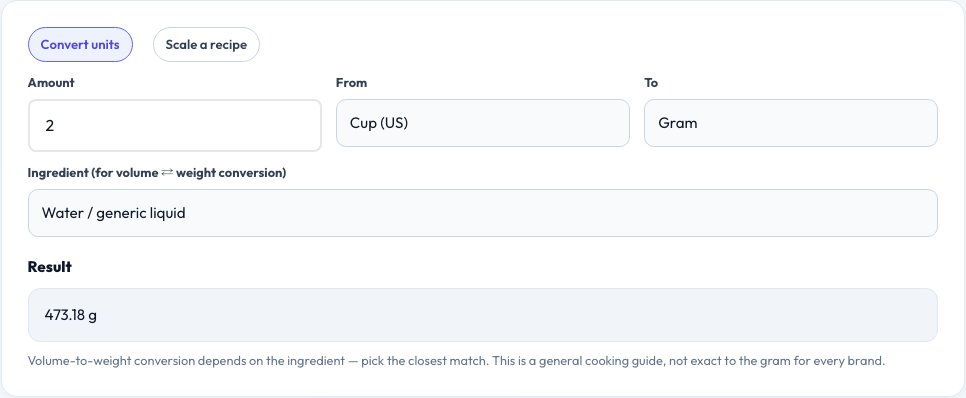
Free Recipe Unit Converter & Recipe Scaler
Recipes from other countries or older cookbooks often use cups and spoons instead of grams, or the wrong servings for your table. This tool has two calculators in one: a cooking measurement converter for volume (cups, tablespoons, teaspoons, millilitres, litres, fluid ounces) and weight (grams, kilograms, ounces, pounds), and a recipe scaler that multiplies every ingredient when you change the number of servings.
Volume-to-weight conversion depends on the ingredient's density, so the converter includes presets for water, flour, sugar, butter and rice as well as a generic option, and shows the result to two decimal places so measuring cups and kitchen scales stay accurate.
Key features
Volume and weight together
Cups, tablespoons, teaspoons, ml, litres, grams, ounces, pounds.
Ingredient-aware
Presets for flour, sugar, butter, rice and water density.
Recipe scaler
Type an ingredient amount and the servings you want instead.
Instant, private
Everything calculates as you type, nothing is uploaded.
How to use it
- Choose Convert units or Scale a recipe.
- For units, enter the amount and pick the ingredient.
- For scaling, enter the original servings, new servings and an ingredient amount.
- Read the converted or scaled amount.
Worked example
Example
2 cups of flour → 240 g (flour preset).
Recipe for 4 servings, 300 g pasta → scaled to 6 servings → 450 g pasta.
Who uses this tool
Home cooks
Convert a US recipe to metric or the reverse.
Bakers
Get an accurate gram weight instead of guessing with cups.
Meal preppers
Scale a recipe up for a crowd or down for one.
Tips for the best results
- Weigh flour and sugar rather than scooping loosely packed cups for the most accurate baking.
- Butter converts differently from liquids — use the butter preset.
- Round scaled amounts sensibly; half an egg means round up to a whole egg.
- Keep the original recipe amounts noted in case you need to scale again later.
Common mistakes to avoid
- Using a generic water-density conversion for flour or sugar, which weighs less than water.
- Scaling spices and leavening (salt, baking powder) linearly on very large batches — taste and adjust.
- Forgetting that pan size and cooking time also need to change when you scale a recipe.
Why use AZRS QuickFix?
It is 100% free, needs no signup and has no watermark or usage limits. The tool runs in your browser, so what you type stays on your device, and it works on phones, tablets and desktops. New tools are added every week — bookmark this page or browse the full QuickFix toolbox.
Frequently asked questions
How many grams are in a cup of flour?
About 120 g of plain flour per US cup, though it varies with how tightly it is packed; this tool uses a standard average.
How do I double a recipe?
Use the scaler: enter the original servings, twice that number as the new servings, and each ingredient amount.
Is a US cup the same as a UK cup?
No — a US cup is 236.6 ml and an Australian/UK metric cup is 250 ml. Check which your recipe uses.
Why does butter convert differently from water?
Butter is less dense than water, so the same cup weighs less in grams — the butter preset accounts for this.
Can I convert teaspoons to millilitres?
Yes, 1 US teaspoon is 4.93 ml, included as a direct option.
Is my recipe data saved?
No, nothing is stored or sent anywhere; it only exists in the calculator while the page is open.