Big Mac Index Currency Comparator
Compare real purchasing power between countries using The Economist's real published Big Mac Index data · free, no signup
How Big Mac Index Currency Comparator works, step by step
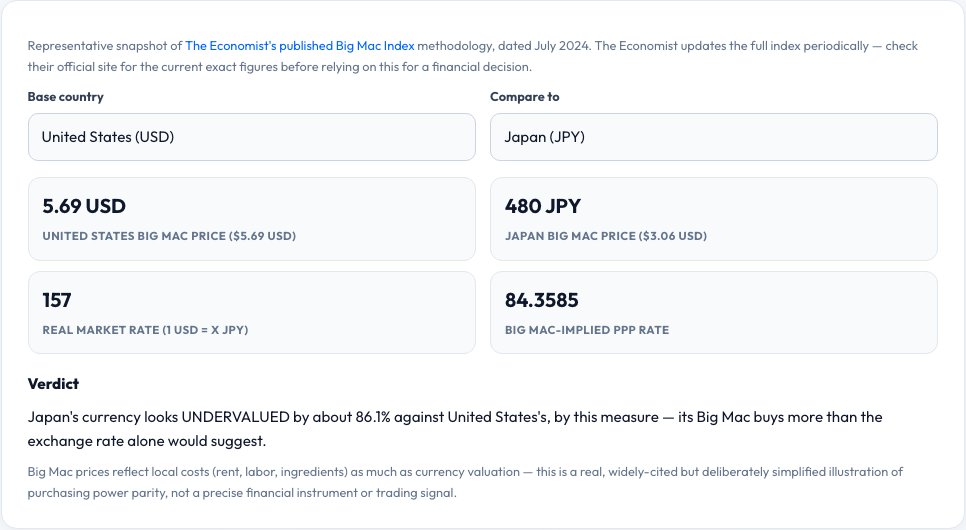
Choose your base country and a country to compare.
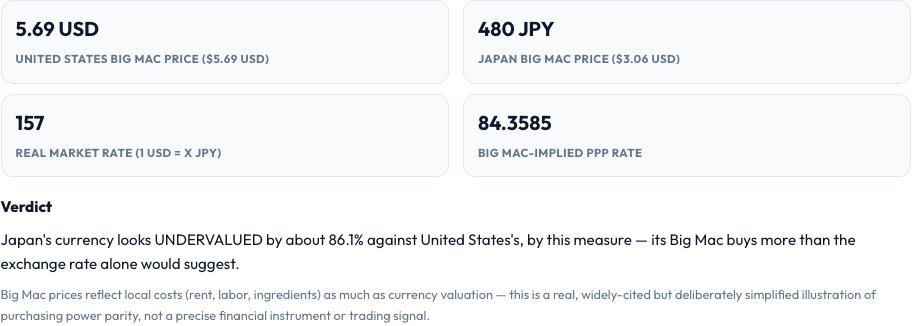 Download it
See each country's real published local Big Mac price, converted to US dollars.
Big Mac Index Currency Comparator
The Economist's Big Mac Index is a real, published measure of purchasing power parity: since a Big Mac is a near-identical product sold in the same way in dozens of countries, comparing its local price (converted to US dollars at the real market exchange rate) reveals whether a currency is trading cheaper or more expensive than its actual local purchasing power would predict. This tool embeds a representative snapshot of that real published dataset (local Big Mac price, USD-converted price and the implied PPP exchange rate for a wide set of countries) and lets you compare any two.
The result shows the real market exchange rate, the implied purchasing-power-parity rate the Big Mac prices suggest, and the percentage by which the second country's currency is over- or under-valued relative to the US dollar by this measure — a real, simple way to compare relative cost of living and currency valuation, not a live financial forecast.
Key features
Real published dataset, not invented numbers
Uses a representative snapshot of The Economist's actual published Big Mac Index prices, clearly dated.
Implied PPP exchange rate
Calculates the real purchasing-power-parity rate the local Big Mac prices imply, not just a raw price difference.
Over/under-valuation percentage
Shows exactly how far a currency's market rate diverges from its Big Mac-implied purchasing power.
Any two countries compared directly
Pick any pair from the dataset to compare their currencies' relative purchasing power.
How to use it
- Choose your base country and a country to compare.
- See each country's real published local Big Mac price, converted to US dollars.
- See the implied purchasing-power-parity exchange rate the two prices suggest.
- See the percentage over- or under-valuation versus the real current market exchange rate.
Worked example
Example
Comparing the US ($5.69 Big Mac) against a country where a Big Mac costs the local-currency equivalent of $3.20 at the real market exchange rate implies that currency is roughly 44% undervalued against the dollar by the Big Mac Index measure — a real, published-methodology way of saying goods are relatively cheaper there than the exchange rate alone suggests.
Who uses this tool
Travelers comparing real cost of living between countries
Get a quick, real sense of relative purchasing power beyond just the raw exchange rate.
Students and readers learning about purchasing power parity
See a concrete, well-known real-world example of the PPP concept in action.
Anyone curious why a currency is called 'overvalued' or 'undervalued' in the news
Understand the real, simple logic behind one commonly cited measure.
Tips for the best results
- Big Mac prices reflect local costs like rent, labor and ingredients as much as currency valuation — economists treat the index as a simplified, illustrative gauge, not a precise financial instrument.
- The embedded dataset is a real but point-in-time published snapshot; The Economist updates the full index periodically, so check economist.com/big-mac-index for the latest exact figures before relying on this for a financial decision.
- Local taxes, import duties on ingredients and different Big Mac recipe compositions between countries can all affect the local price independent of pure currency valuation.
Common mistakes to avoid
- Treating the Big Mac Index as a precise financial exchange-rate forecast rather than the simplified, illustrative comparison it was designed to be.
- Comparing two countries' raw Big Mac prices in local currency without converting to a common currency first — always compare the USD-converted prices, which this tool does automatically.
- Assuming 'undervalued' by the Big Mac Index automatically means a currency will rise — it's a purchasing-power snapshot, not a trading signal.
Why use AZRS QuickFix?
It is 100% free, needs no signup and has no watermark or usage limits. The tool runs in your browser, so what you type stays on your device, and it works on phones, tablets and desktops. New tools are added every week — bookmark this page or browse the full QuickFix toolbox.
Frequently asked questions
What exactly is the Big Mac Index?
A real index published periodically by The Economist since 1986 that uses the price of a Big Mac in different countries (a near-identical product everywhere) to gauge whether currencies are trading cheap or expensive relative to their real local purchasing power — a widely cited, simplified illustration of purchasing power parity.
How is 'undervalued' calculated here?
By comparing the real market USD exchange rate to the implied purchasing-power-parity rate suggested by the two countries' local Big Mac prices — if a currency buys more Big Mac (adjusted to USD) locally than the market rate would suggest, it's shown as undervalued by this measure.
Is this data live and current to today?
No — it's a real, representative snapshot of published Big Mac Index data, clearly dated in the tool; The Economist publishes updated figures periodically, so check their official site for the current exact numbers.
Why use a Big Mac instead of a more 'serious' product basket?
That's exactly the index's original point — a Big Mac is unusually standardized across countries in ingredients, production and retail format, making it an easy, consistent real-world product to compare, unlike most goods which vary a lot between markets.
Can I compare any two countries?
Any two countries included in the embedded dataset, which covers a wide, representative set of the countries The Economist's index tracks.
Is my data stored?
No, everything is calculated locally from the embedded dataset.