3D-Printable Screw Thread Generator (Bolts, Nuts, Lead Screws)
Generate metric (ISO) and trapezoidal threads: bolts, nuts and threaded rods as watertight STL · free, no signup
Thread & part
See 3D-Printable Screw Thread Generator (Bolts, Nuts, Lead Screws) in action
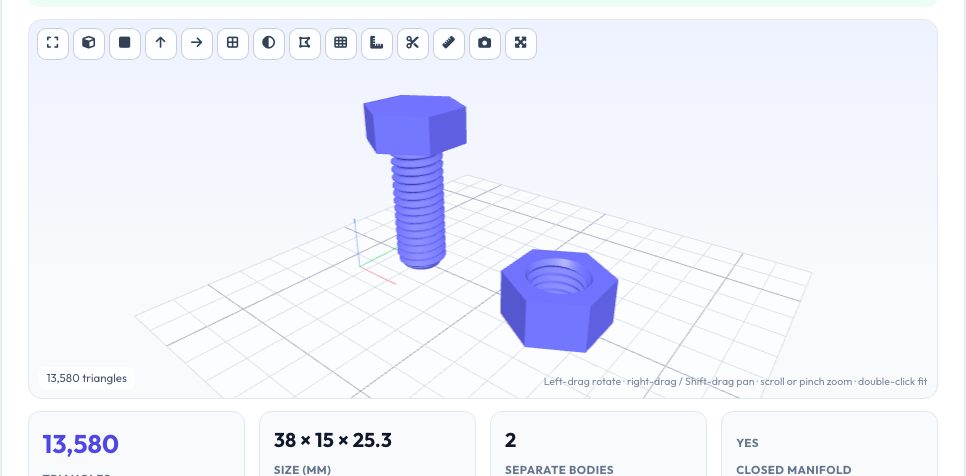
Free 3D-Printable Screw Thread Generator
Printing your own bolts, nuts, knobs and lead screws is easy when the geometry is right — and hard when a thread from the internet is too tight, too loose or not watertight. This generator builds threads from the exact ISO 261/262 basic profile (60°, crest flat P/8, thread depth 0.6134 P on the bolt and 0.5413 P in the nut) or a 30° trapezoidal (Tr) profile with root clearance following DIN 103, for any diameter, pitch and length, right- or left-handed. Pick a standard size from M2 to M24 and the pitch, head and nut dimensions fill in from ISO 4017, 4032 and 4762 tables, or enter a custom size.
The part is built as a single closed, outward-facing triangle mesh — thread surface, end faces and head — so it slices cleanly. A printer clearance (radial, per side) makes the bolt slightly smaller and the nut slightly larger so they thread together; 0.15 mm is a good FDM starting point. You can generate a bolt with a hex, socket-cap or round head, a hex, round or scalloped thumb nut, a threaded rod or lead screw, or a bolt and nut pair laid out together, with chamfered ends so the thread starts easily. Download STL, 3MF, OBJ or PLY.
Key features
Exact ISO and Tr profiles
ISO metric 60° and trapezoidal 30° threads, right or left hand.
Bolts, nuts, rods, pairs
Hex, socket-cap or round heads; hex, round or scalloped nuts.
Printer clearance
Per-side clearance so printed parts actually thread together.
Closed manifold output
Single watertight mesh checked in the page before download.
How to use it
- Choose the part and a standard size (or custom diameter and pitch).
- Set the length, clearance and head or nut style.
- Check the 3D preview and the watertight check.
- Download and print upright with 0.12–0.2 mm layers.
Worked example
Example
An M8 × 1.25 bolt, 20 mm long with a 13 mm hex head and 0.15 mm clearance has a 7.7 mm major diameter, a thread depth of 0.77 mm and about 10,000 triangles at standard quality; the matching M8 nut is 6.8 mm tall with 13 mm across flats.
Who uses this tool
Makers
Replace lost bolts, make knobs, clamps and adjustable parts.
Engineers and students
Prototype lead screws, jacks and fixtures.
Product designers
Threaded lids and bottle caps for printed products.
Tips for the best results
- Print bolts and rods upright; threads printed lying down lose accuracy.
- Print a short test pair first and tune the clearance in 0.05 mm steps.
- Use 3+ walls and no infill concerns in the thread region.
- Use trapezoidal threads for lead screws — they are stronger and self-aligning.
Common mistakes to avoid
- Using a clearance of 0 and getting a seized thread.
- Choosing a fine pitch with a 0.6 mm nozzle — the thread cannot resolve.
- Expecting printed threads to carry the load of steel bolts.
Why use AZRS QuickFix?
It is 100% free, needs no signup and has no watermark or usage limits. The tool runs in your browser, so what you type stays on your device, and it works on phones, tablets and desktops. New tools are added every week — bookmark this page or browse the full QuickFix toolbox.
Frequently asked questions
Do printed nuts fit steel bolts?
Often with +0.2 mm clearance, but use the nut-only option and print a test.
Which pitches work best on FDM?
Coarse pitches (M6 and up) and trapezoidal threads.
Is the mesh watertight?
Yes — a single closed manifold, verified in the page.
Is it private?
Yes, nothing is uploaded.