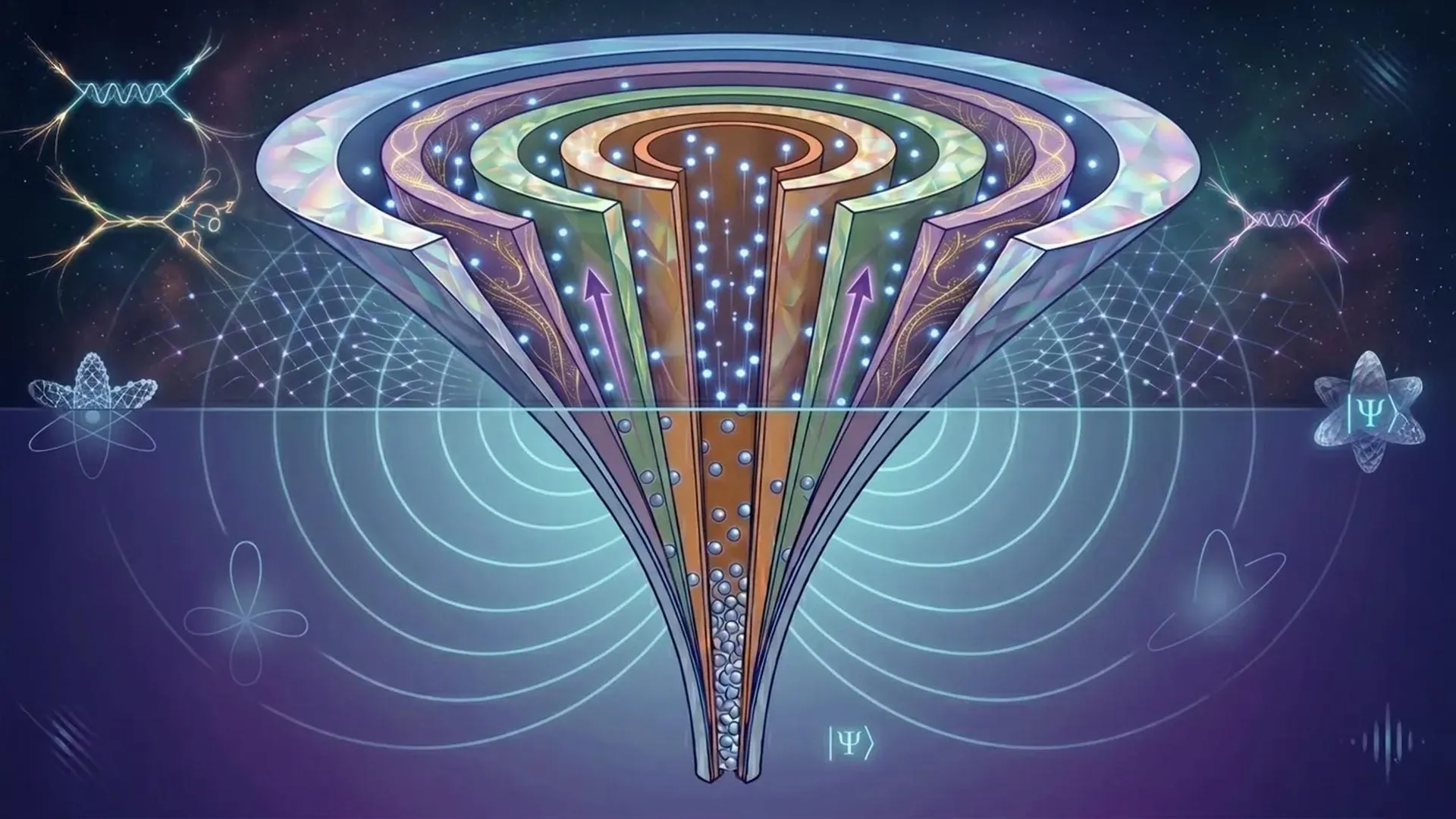
Max Planck Institute researchers simulate particle-antiparticle pair production with ultracold rubidium atoms.
Researchers at the Max Planck Institute have successfully simulated particle-antiparticle pair production using ultracold rubidium atoms, demonstrating the Schwinger effect for the first time in a la…

Scientists at the Max Planck Institute for Quantum Optics have used ultracold atoms to mimic the creation of particle‑antiparticle pairs from a strong electric field, a phenomenon predicted by quantum electrodynamics but never directly observed in the laboratory. The experiment, reported on Phys.org, employed a cloud of rubidium atoms cooled to near absolute zero and arranged in an optical lattice that acted like a synthetic electric field. When the field was switched on, the atoms behaved as if they were electrons and positrons being torn from the vacuum, providing the first tabletop demonstration of the elusive “Schwinger effect.”
The breakthrough comes at a time when physicists are seeking ways to test the limits of quantum field theory without building massive particle accelerators. In the 1950s, Julian Schwinger calculated that an electric field stronger than about 10¹⁸ volts per metre could rip apart the vacuum and spawn electron‑positron pairs. Such fields exist only in extreme astrophysical events or in the fleeting moments of high‑energy collisions, making direct measurement impossible. By translating the problem into the language of ultracold atoms, researchers can explore the same physics at far lower energies, using laser‑controlled potentials to simulate the required field strengths.
The team measured the rate at which the synthetic pairs appeared and found it matched the theoretical predictions of Schwinger’s formula within experimental uncertainty. They also observed how the pair production slowed when the simulated field was reduced, confirming the exponential dependence on field strength. Lead researcher Dr. Lena Hoffmann said the result “opens a new window on non‑perturbative quantum phenomena that were previously out of reach.” The work builds on earlier demonstrations of analog quantum simulations of relativistic particles using cold‑atom systems.
Next, the researchers plan to extend the simulation to include magnetic fields and to explore pair production in higher dimensions. Doing so could shed light on processes that shaped the early universe and on the behavior of matter under the extreme conditions found in neutron stars. The approach may also inform future high‑intensity laser experiments that aim to reach the Schwinger limit directly, offering a benchmark for interpreting those results.
Read Full Story at Phys.org →