This million-year-old 'baby planet' is the youngest world scientists have ever discovered
A "baby" exoplanet, discovered emerging from its cosmic cocoon around a nearby star, is the youngest alien world ever seen, a new study reveals. The planetary infant is less than 1 million years old …
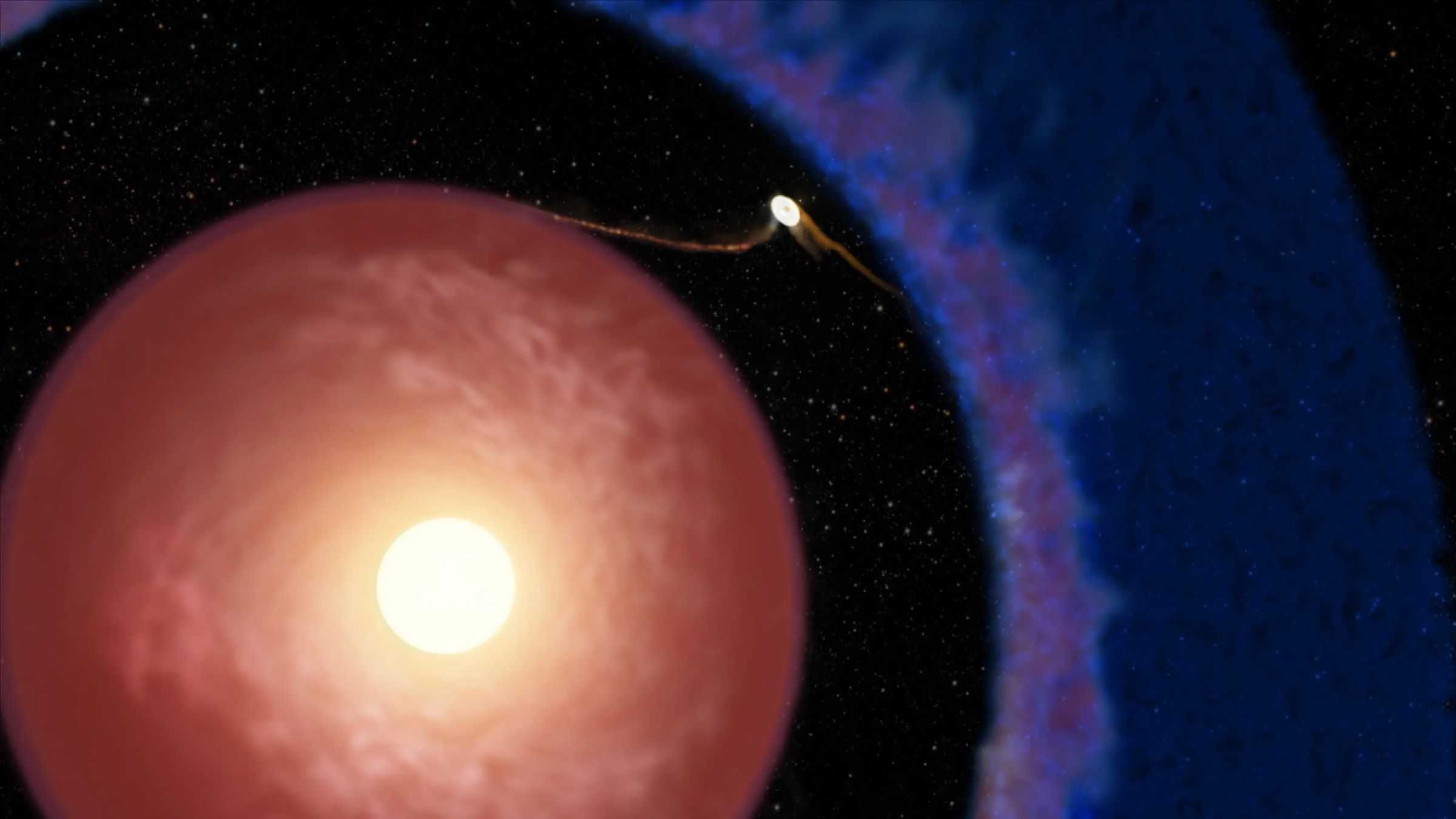
A "baby" exoplanet, discovered emerging from its cosmic cocoon around a nearby star, is the youngest alien world ever seen, a new study reveals. The planetary infant is less than 1 million years old and could help researchers study how other planets, including our own, took shape.
The juvenile world, dubbed Elias 2-24 b , orbits a newly formed star around 450 light-years from Earth. It is somewhere between two and four times as massive as Jupiter and almost twice as far from its home star as Neptune is from the sun .
Astronomers spotted initial signs of the hefty exoplanet in 2017 , when they noticed a small gap in the star's protoplanetary disk — the swirling ring of gas, dust and other stellar debris left over from the star's creation. This gap strongly implied that an exoplanet had formed there after enough of the disk's spinning material had gravitationally clumped together, the process by which most planets form . However, the alien world was not directly visible at the time.
In the new study, published Sept. 16 in The Astrophysical Journal Letters , researchers combined observations from three telescopes — the W. M. Keck Observatory in Hawaii, the Atacama Large Millimeter/submillimeter Array in Chile and the European Southern Observatory’s Very Large Telescope, also in Chile — to take a closer look at the gap in the protoplanetary disk. Not only was the team able to directly image Elias 2-24 b and confirm its existence, but the researchers also dated it, revealing that the alien world is likely less than 1 million years old.
"What makes Elias 2-24 b so remarkable is its age," study first author Andrea Bernardi , a doctoral student with the Institute of Astrophysical Studies (IEA) at Diego Portales University in Chile, said in a statement . "This is the youngest planet detected so far, and because it is still actively accreting material from its surroundings, we're able to observe a stage of planet formation that is rarely seen directly."
The newly confirmed exoplanet is roughly 5,000 times younger than Earth or around 0.008% the age of the oldest known exoplanet, PSR B1620-26 b or "Methuselah," which formed around 1.1 billion years after the Big Bang. Compared to the average human lifespan, this makes Elias 2-2 b roughly equivalent to a two- or three-day-old baby.
This is not the first time that astronomers have spotted baby exoplanets. But until recently, there has been an age limit on when they become visible to us.
Get the world’s most fascinating discoveries delivered straight to your inbox.
Read Full Story at Live Science →