'The greatest unknown was how much energy would be released by the weapon': How scientists prepared for the Trinity nuclear test
In the early hours of July 16, 1945, in a remote part of the New Mexico desert, a group of scientists, engineers and military personnel attended an event that would define the course of history and c…
In the early hours of July 16, 1945, in a remote part of the New Mexico desert, a group of scientists, engineers and military personnel attended an event that would define the course of history and change a war that had ravaged much of the world for years. Moments after a giant fireball rose high into the sky, a huge shock wave thundered toward the onlooking crowd. The Trinity nuclear test had been a success.
The story of the Manhattan Project is well known. But one area that may be overlooked is the human effort involved in bringing the mission to life. In her new book " Trinity: An Illustrated History of the World’s First Atomic Test " (The University of Chicago Press, 2026), author Emily Seyl, a science writer and editor at the Los Alamos National Laboratory's National Security Research Center, uses never-before-seen photography from the laboratory’s legacy collections to highlight the physical and mental effort that went into the project.
In this excerpt, Seyl examines one of the key elements of any scientific experiment — how to successfully measure the results. She looks at how experiments were decided upon and the ways in which success would be measured, beyond the visual spectacle of a successful detonation of "the Gadget."
The most rudimentary measure of success would, of course, be the eye test: Did the Gadget produce a nuclear explosion? Beyond the answer to this simple question, however, the detonation was also a monumental and complicated science experiment — one that naturally gave rise to as many smaller experiments as could be squeezed, sometimes impractically, into the test plans.
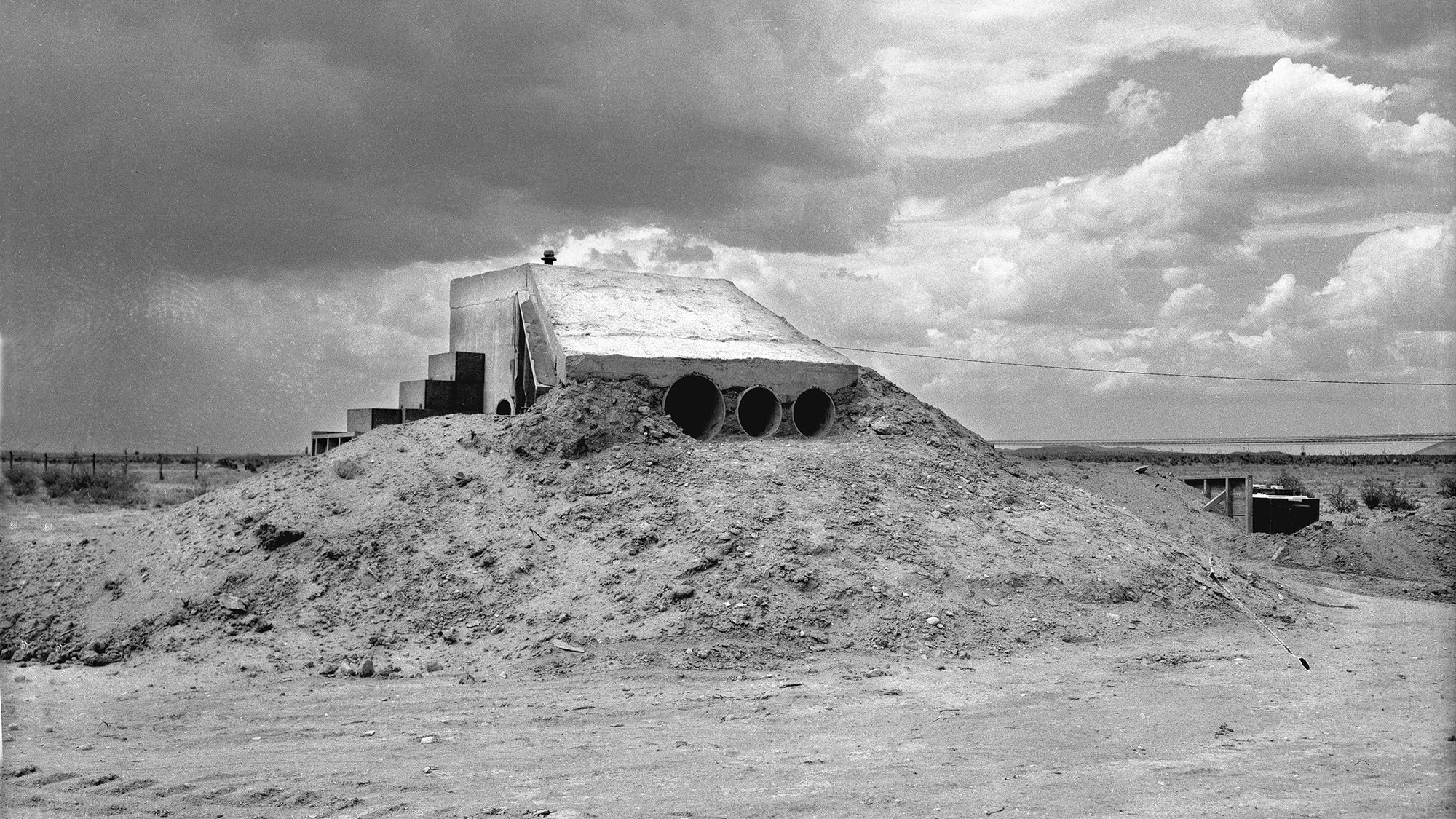
Alongside a crowd of Trinity contributors, a robust collection of electronic and mechanical observers was stationed carefully throughout the desert to bear witness to the shot. Although deceptively rugged and nondescript, these devices were highly sophisticated, often employing first-of-their-kind technologies — invented and built by some of the world's preeminent researchers to study a first-of-its-kind event.
After two years of leapfrogging basic nuclear studies in their rush to produce a workable device, the pioneering scientists now "yielded to temptation and conceived experiment after experiment" in anticipation of the Trinity test — much to Kenneth Bainbridge's [director of the Manhattan Project's Trinity nuclear test] alarm. In December of 1944, with base camp still under construction at the test site, a selection committee, headed by Bainbridge, had been established to evaluate what was quickly becoming a deluge of ideas.
The committee implemented a detailed submission process, requiring scientists to scrupulously outline the personnel and material needs associated with carrying out each idea. Proposed subtests were triaged into three categories: essential experiments, which were fully greenlit no matter the required effort or resources; desirable experiments, which were approved only if they did not interfere with work on the Gadget itself; and unnecessary (i.e., nonessential) experiments, of which only the simplest were allowed.
Completing the Gadget remained the top priority. But while most of the lab continued to work feverishly on readying the test device, a significant battery of physicists, photographers, chemists, engineers, and other specialists began coming and going between Los Alamos and the Trinity site in March, as Jumbo [a containment vessel for use in case the nuclear explosion failed] faded into the background. With confidence increasing and a clear emphasis on learning everything possible about the performance of the test device, they were consumed from dawn to dusk with readying cameras and other diagnostic instrumentation to track the effects of the blast from detonation to dissipation.
Read Full Story at Live Science →