Scientists build tiny robots without motors that can fly using sound waves alone
If you blow across the top of an empty bottle you'll hear a clear, steady note. Now, engineers have used that same concept to power tiny robots that move without a single motor on board. These new d…
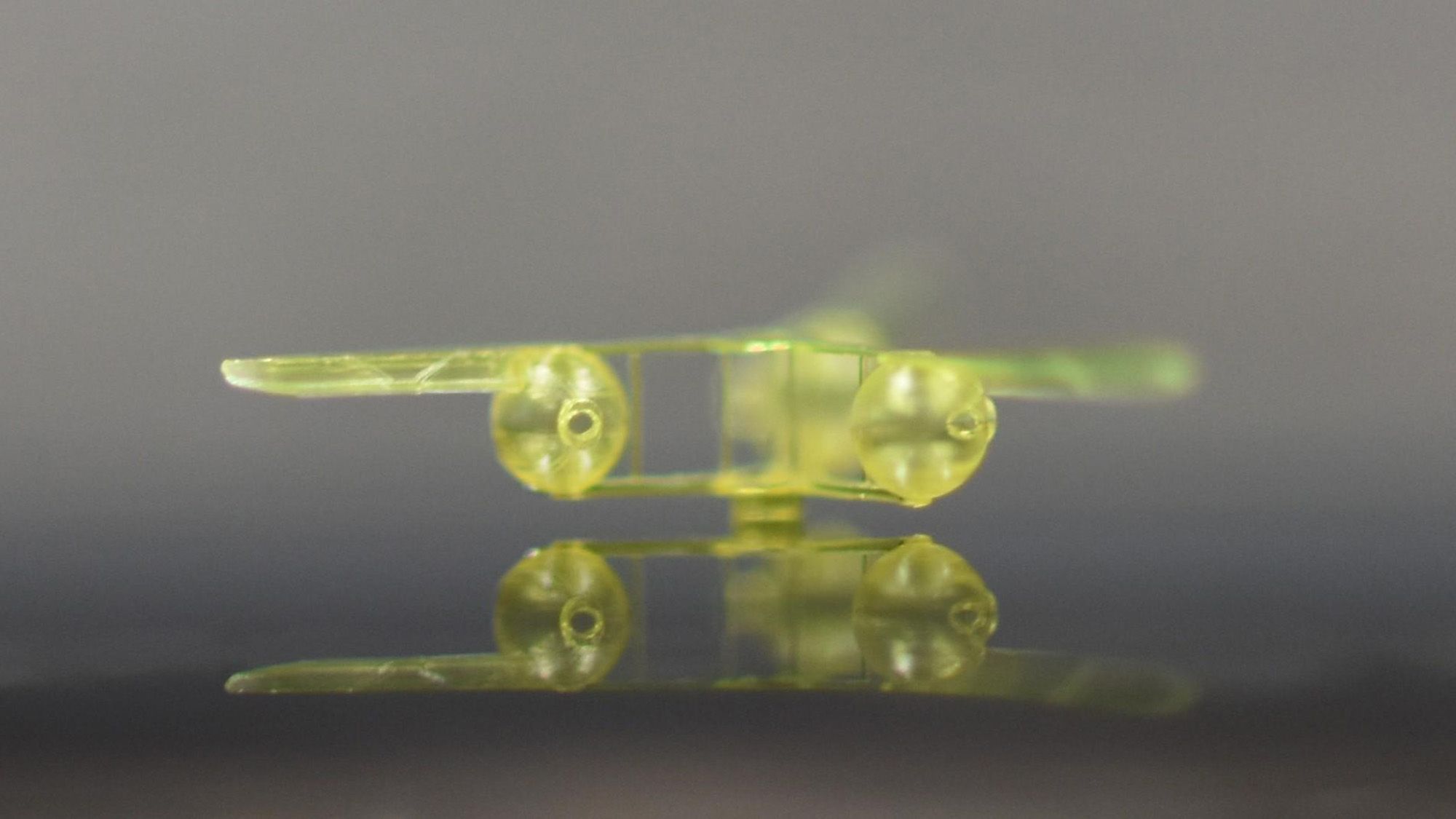
If you blow across the top of an empty bottle you'll hear a clear, steady note. Now, engineers have used that same concept to power tiny robots that move without a single motor on board.
These new devices are powered entirely by sound. When the right frequency is aimed at them, hollow chambers built into their structure resonate and push out a jet of air, generating enough thrust to steer a small boat or lift a tiny flying robot off the ground.
The scientists described their innovation in a study published Aug. 12 in the journal Science Advances .
The effect behind it, known as Helmholtz resonance , was first studied in 1856 by the German physicist Hermann von Helmholtz , who was trying to invent a tool for tuning musical instruments. He noticed that when air trapped inside a cavity resonates, it also pushes out a faint jet of air.
"It isn’t very powerful when you do it with a musical instrument, because pressure is low," said study co-author Selman Sakar , an associate professor of mechanical engineering at the Swiss Federal Technology Institute of Lausanne (EPFL) in Switzerland. "But if you could crank up the pressure, all of a sudden that jet could become significant... in a way that the force can be harnessed for machinery," he told Live Science.
The team realized that shrinking Helmholtz's resonators down would push the frequency needed to activate them into the ultrasonic range — meaning it's too high-pitched for humans to hear and, crucially, easier to focus with precision. Larger versions generating the same force would need audible sound loud enough to be both annoying and potentially harmful, Sakar said.
Using a specialized 3D-printing technique called two-photon printing, the researchers built hollow structures based on Helmholtz's original equations and confirmed with lab tests and computer simulations that they generated thrust as predicted.
Get the world’s most fascinating discoveries delivered straight to your inbox.
Read Full Story at Live Science →