NASA's New Horizons detects liquid nitrogen flow on Pluto's glacier
NASA's New Horizons has discovered evidence of liquid nitrogen flow on Pluto, indicated by dark streaks on the Sputnik Planitia glacier. This suggests Pluto's interior is warmer and its surface more …
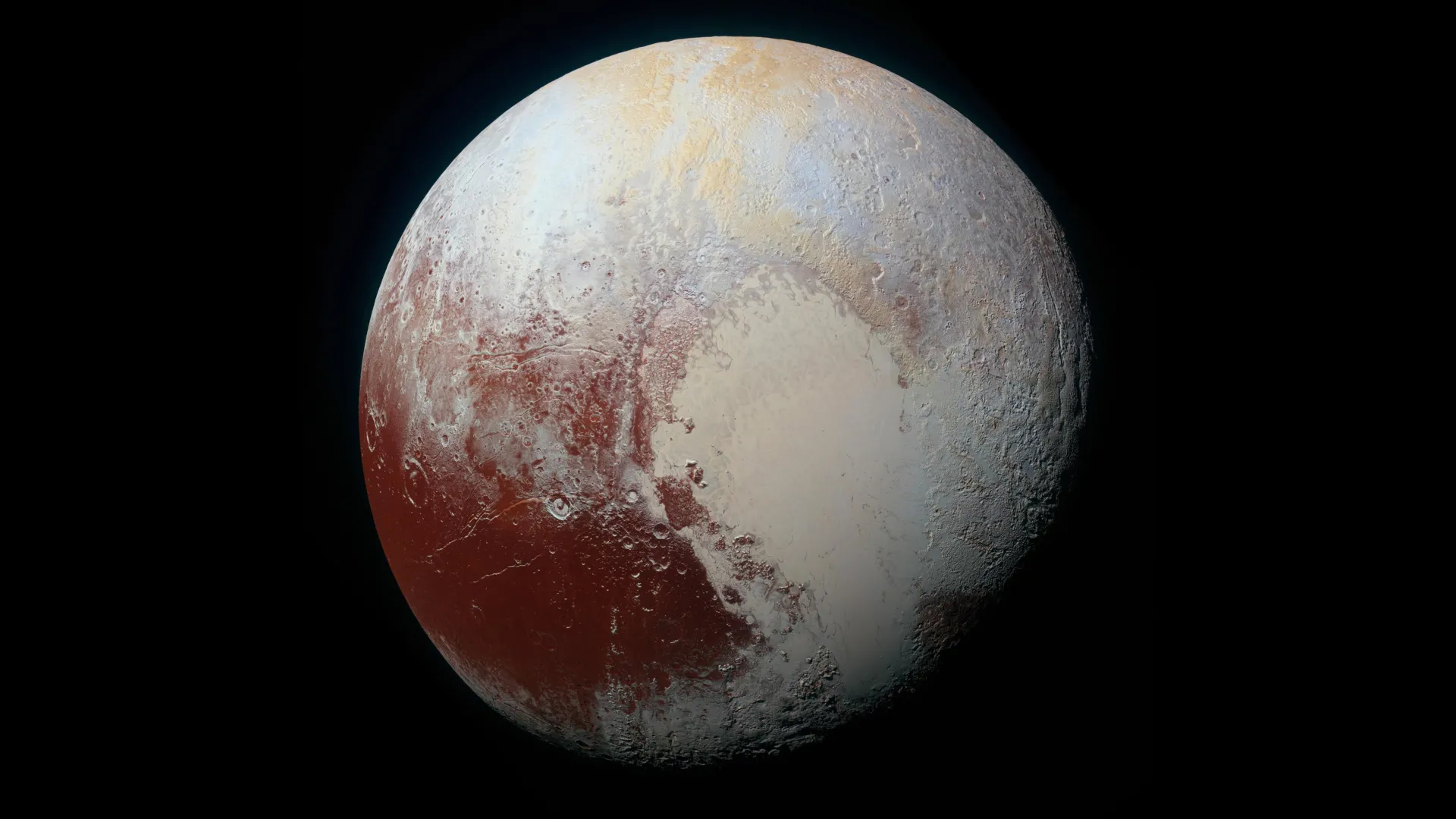
NASA’s New Horizons spacecraft has found the first evidence that liquid nitrogen once flowed across Pluto’s surface. The discovery comes from dark streaks and patches on the giant Sputnik Planitia glacier that look like channels carved by fluid. Scientists say the features match a scenario in which nitrogen melted at the base of the ice and rose up through cracks, leaving behind the dark marks now visible from orbit.
Pluto has long been pictured as a frozen, inert world. The dwarf planet’s surface is mostly frozen nitrogen, methane and carbon monoxide, and it was assumed that its geology had long since stopped. New Horizons, which flew by Pluto in 2015, revealed a surprisingly young landscape with layered ice and possible tectonic activity. The new finding builds on that evidence, showing that the planet may still be reshaping itself even after the spacecraft left.
Computer simulations support the idea that nitrogen can melt at the bottom of Sputnik Planitia, where pressure and heat from the planet’s interior could raise temperatures above the nitrogen melting point. The melt would then travel upward through narrow tunnels, leaving a trail of darker material as it cooled. The dark streaks are roughly a few kilometers long and a few hundred meters wide, matching the scale of the modeled conduits. The study was led by researchers at the University of Colorado Boulder and the University of Arizona, and it was published in the journal Nature Geoscience.
If Pluto’s ice can melt and flow, it means the dwarf planet’s interior is warmer than previously thought, and its surface is more dynamic. The result may change how scientists think about other icy bodies in the Kuiper Belt. Future missions could look for similar fluid activity on bodies like Eris or Haumea, and the data may help refine models of planetary cooling and tectonics in the outer solar system.
Read Full Story at ScienceDaily →