Does water drain in different directions in the Northern and Southern hemispheres?
There's a commonly cited idea that water in a drain swirls in opposite directions in the Northern and Southern hemispheres. But is there any truth to it? When you pull the plug from a bathtub, does t…
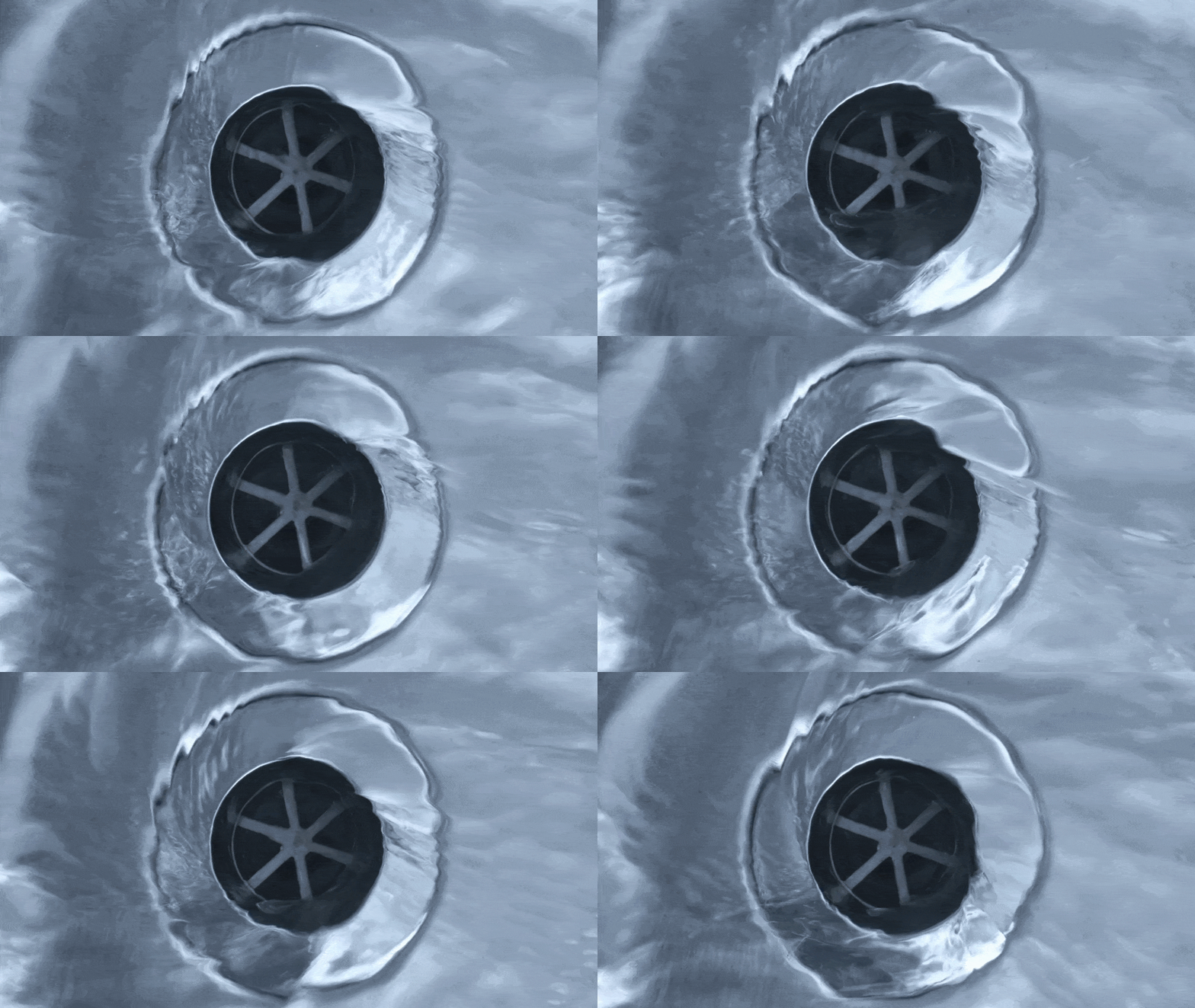
There's a commonly cited idea that water in a drain swirls in opposite directions in the Northern and Southern hemispheres. But is there any truth to it? When you pull the plug from a bathtub, does the water circle one way in New York and the other way in Sydney?
Although the idea is based on a real scientific principle, you probably won't see it play out in a small drain in your house, experts told Live Science.
The idea that water spins in opposite directions in the Northern and Southern hemispheres stems from a phenomenon known as the Coriolis effect . When something, including air or water, moves across Earth as it rotates on its axis, that substance appears to curve because the ground beneath it is rotating at different speeds in different places. Points close to the equator move faster than points near the poles because they have a bigger circle to travel in the same 24 hours.
Over the immense distances covered by weather systems and ocean currents, that small deflection can accumulate and become important. The key words here are "immense distances." The Coriolis effect is weak, so it needs enough time and space to produce a noticeable change. Storms and weather patterns can persist for days and stretch across hundreds of miles. But water in a sink, bathtub or toilet has only seconds to move before disappearing down the drain.
"You always need to think about the right timescales and length scales," Susanne Horn , a professor of numerical and mathematical fluid dynamics at Coventry University in the U.K., told Live Science.
Sign up for our weekly Life's Little Mysteries newsletter to get the latest mysteries before they appear online.
At your bathroom's scale, seemingly trivial details take control. The water may already be rotating slightly because of how it entered the basin, how somebody moved in the bath or how the plug was removed. The sink and drain are unlikely to be perfectly symmetrical, which can also play a part, and the design of a toilet deliberately guides its water. All of these factors are more influential on your basin than the Coriolis effect is. (In other words, that episode of "The Simpsons" , which features Bart investigating drainage direction in Australia versus the U.S., got it wrong.)
Consequently, the same sink can drain clockwise on one occasion and counterclockwise on another, depending on the variation of these variables on any given day; the direction depends principally on how the water was introduced and the geometry of the container and drain, according to the Library of Congress .
Read Full Story at Live Science →