2,600 silver coins found in outskirts of Moscow may have been buried by a medieval plague victim
Archaeologists in Russia have unearthed a medieval hoard of 2,600 silver coins, including more than 350 coins of a type never seen before. The hoard may have been buried by a nobleman who later fell …
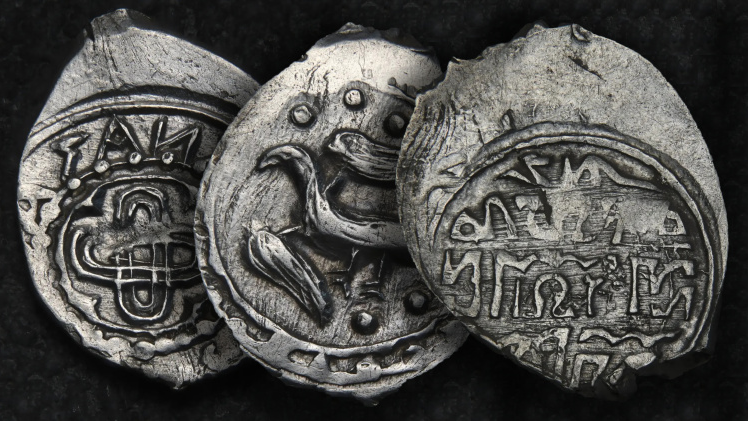
Archaeologists in Russia have unearthed a medieval hoard of 2,600 silver coins, including more than 350 coins of a type never seen before. The hoard may have been buried by a nobleman who later fell victim to a plague.
The coins were found in an elegant ceramic jug, according to an Aug. 26 translated statement from the Institute of Archaeology of the Russian Academy of Sciences. The jug was buried in a pit in what is now the historic center of Kolomna, a city about 71 miles (114 kilometers) southeast of the city of Moscow. In the 14th and 15th centuries, Kolomna was the second-most-important city in the region.
Most of the silver coins are a type called a denga . Dengi were first minted in the late 14th century by the Grand Principality of Moscow, a late medieval Russian monarchy. Each denga was worth half a kopek, and there were 100 kopeks to a ruble. The coin hoard is dominated by coins minted in Kolomna under Vasily I (who reigned from 1389 to 1425) and Vasily II (who reigned from 1425 to 1462), according to the statement. These rulers were both grand princes of Moscow, as the city and its wider region were part of an independent principality at the time.
One of the most interesting coin types is an extremely rare denga that features a bird in flight, which was produced during the final years of the reign of Vasily I, according to the statement. Additionally, more than 350 of the coins are previously unknown varieties minted in Kolomna, which experts are now studying.
The person who buried the Kolomna hoard was likely a wealthy, high-status person, such as a high-ranking government official or an extremely successful merchant, according to the statement.
While it is unclear why the hoard was buried, experts think the date of the coins provides an important clue. The most recent coins were minted in the second half of the 1420s, according to the statement. This suggests that the hoard's owner could have fallen victim to a plague epidemic that swept through Russian principalities from 1424 to 1427.
See if you know what these mysterious artifacts are with our archaeological fragments quiz!
Get the world’s most fascinating discoveries delivered straight to your inbox.
Read Full Story at Live Science →