Two Americans win Nobel Prize in Economics for work on boom-bust cycles
U.S. economists Robert E. Hall and Michael Woodford are announced as the winners of the 2026 Nobel prize in economics at the Royal Swedish Academy of Sciences in Stockholm on Monday. JONATHAN NACKSTR…
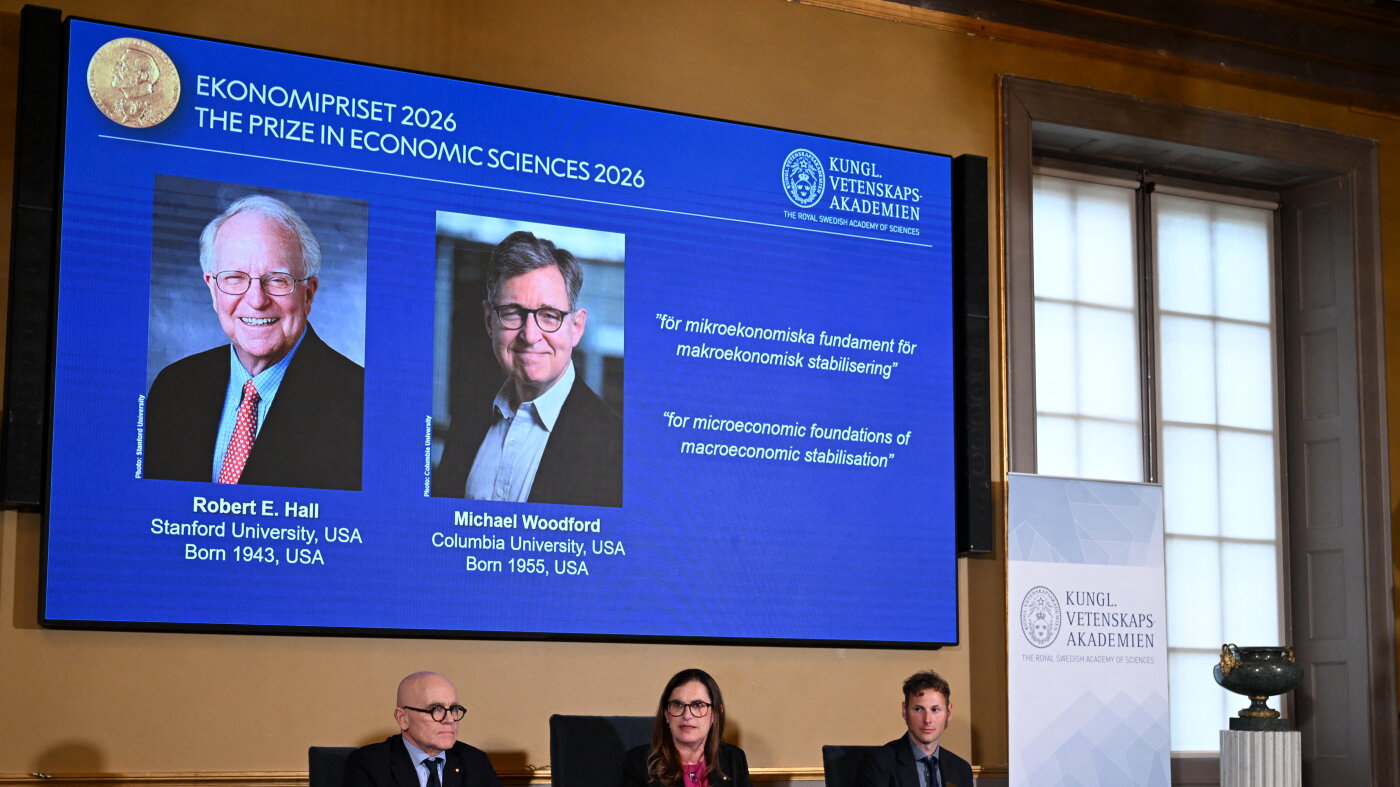
U.S. economists Robert E. Hall and Michael Woodford are announced as the winners of the 2026 Nobel prize in economics at the Royal Swedish Academy of Sciences in Stockholm on Monday. JONATHAN NACKSTRAND/AFP via Getty Images/AFP hide caption
Sign up for the Planet Money newsletter. The world is confusing. Economics can help
Two Americans have won the Nobel Prize in Economics for their work on how to smooth boom-and-bust cycles to limit inflation and unemployment.
Robert Hall of Stanford University and Michael Woodford of Columbia University were honored for their focus on how individual households and businesses make decisions on purchases and pricing — work that became the foundation of the "New Keynesian" approach to economics.
The importance of that work has been underscored in recent years by the pandemic, which pushed millions of people out of work, and the supply shocks that followed, driving up the cost of living.
"Regardless of the causes, an important goal for governments and central banks is to reduce the amplitude of these swings and limit the risk that the economy gets stuck in a situation with high unemployment or loses control over inflation," said John Hassler, the chairman of the economic prize committee.
After the Great Depression, John Maynard Keynes persuaded policymakers that government sometimes needed to stimulate demand during downturns to curb unemployment, or tamp down demand during boom times to limit inflation.
"This is the Keynesian recipe, and it worked well until it didn't," said Tim Boppart, a member of the prize committee. In the 1970s, the economy was hit by rising unemployment and inflation simultaneously.
Read Full Story at NPR News →