'There is no conflict between quantum physics and gravity': Physicists prove Einstein's 'happiest thought' holds true at quantum scales
For the first time, physicists have measured the tiny quantum shift an object acquires by falling through Earth's gravity — an effect of Einstein's relativity that was predicted almost a century ago …
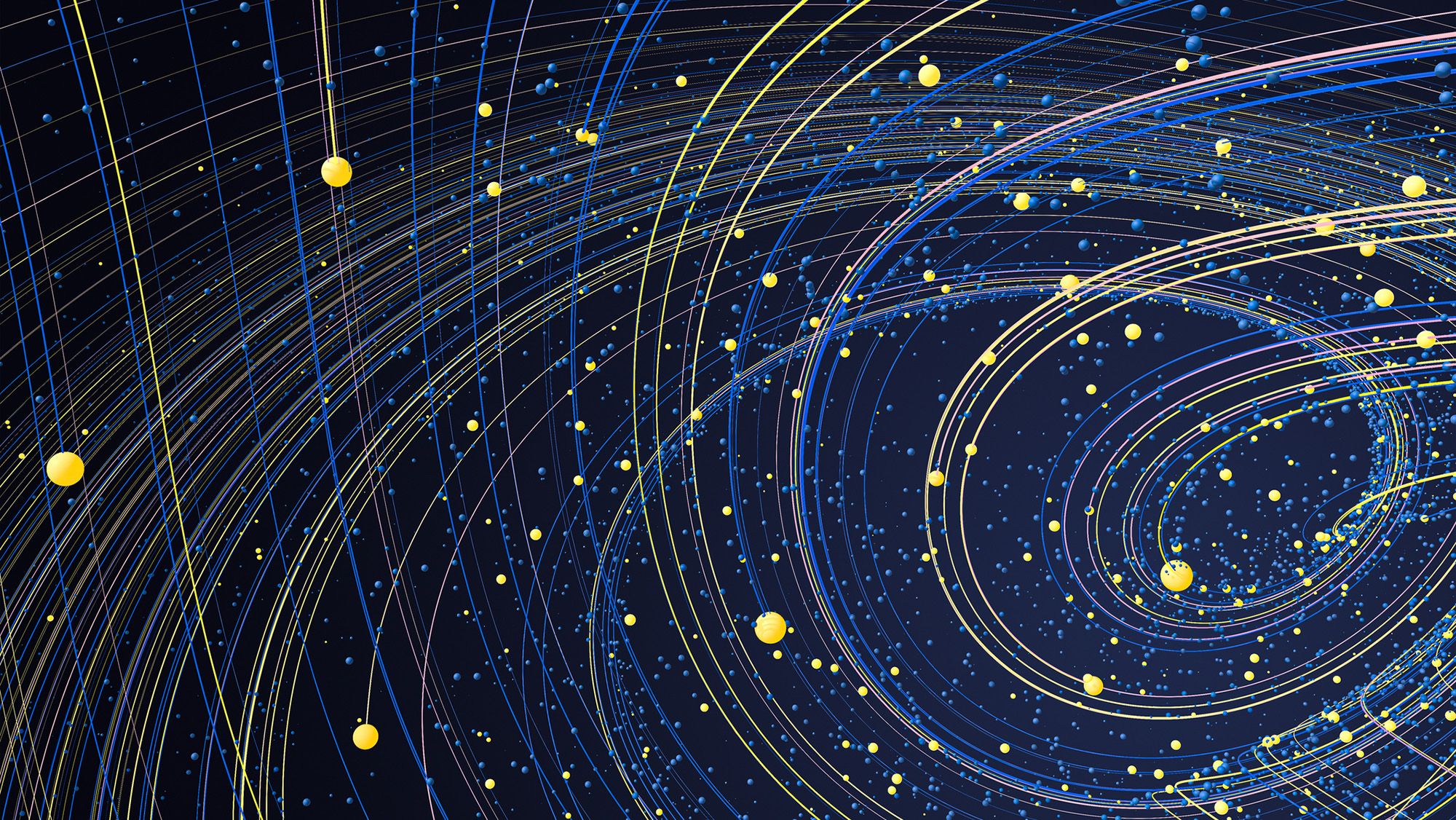
For the first time, physicists have measured the tiny quantum shift an object acquires by falling through Earth's gravity — an effect of Einstein's relativity that was predicted almost a century ago but never observed.
Researchers placed ultracold rubidium atoms into a superposition, a quantum state in which a single particle takes two paths at once. In this experiment, one path put the atom in free fall while the other kept it motionless. Recombining the atoms revealed an almost imperceptible difference between the two paths.
The measurement, published Sept. 2 in the journal Science Advances , shows that Einstein's equivalence principle — the idea at the heart of general relativity — still holds when it is pushed into the quantum world, creating a small but tantalizing link between relativity and quantum mechanics .
"The principle says that acceleration and gravity cannot be distinguished locally," Vlatko Vedral , a physicist at the University of Oxford and a co-author of the new study, told Live Science via email.
The classic illustration of the equivalence principle is a thought experiment known as Einstein's elevator. A person sealed in a windowless elevator cannot tell whether the floor is pressing against their feet because the elevator is parked motionless on Earth or because it is being accelerated through empty space. Einstein called that realization the "happiest thought" of his life and built general relativity around it.
For heavy, everyday objects, the equivalence principle has been tested to extraordinary precision. Quantum objects are a different matter. They behave like waves, and each wave carries a quantity called phase — essentially, where its crests and troughs sit. Phase cannot be seen directly, but when two versions of the same particle are recombined, any mismatch between their phases shows up as an interference pattern. The two waves reinforce each other in some places and cancel each other out in others, thereby changing the odds of where the particle turns up.
Theory says that a wave in free fall should build up phase relative to an identical wave held still and that this phase should grow with the cube of the falling time. Therefore, doubling the fall time multiplies the effect eightfold. Charles Galton Darwin, a grandson of the famous naturalist, and Earle Kennard both documented this prediction in 1927 — but no one had measured it until now.
Get the world’s most fascinating discoveries delivered straight to your inbox.
Read Full Story at Live Science →