BepiColombo reaches Mercury after 8-year journey
BepiColombo, launched in 2018, successfully deployed its two orbiters after an eight-year journey to study Mercury’s surface, core, and magnetic field, aiming to uncover secrets like water ice and pl…
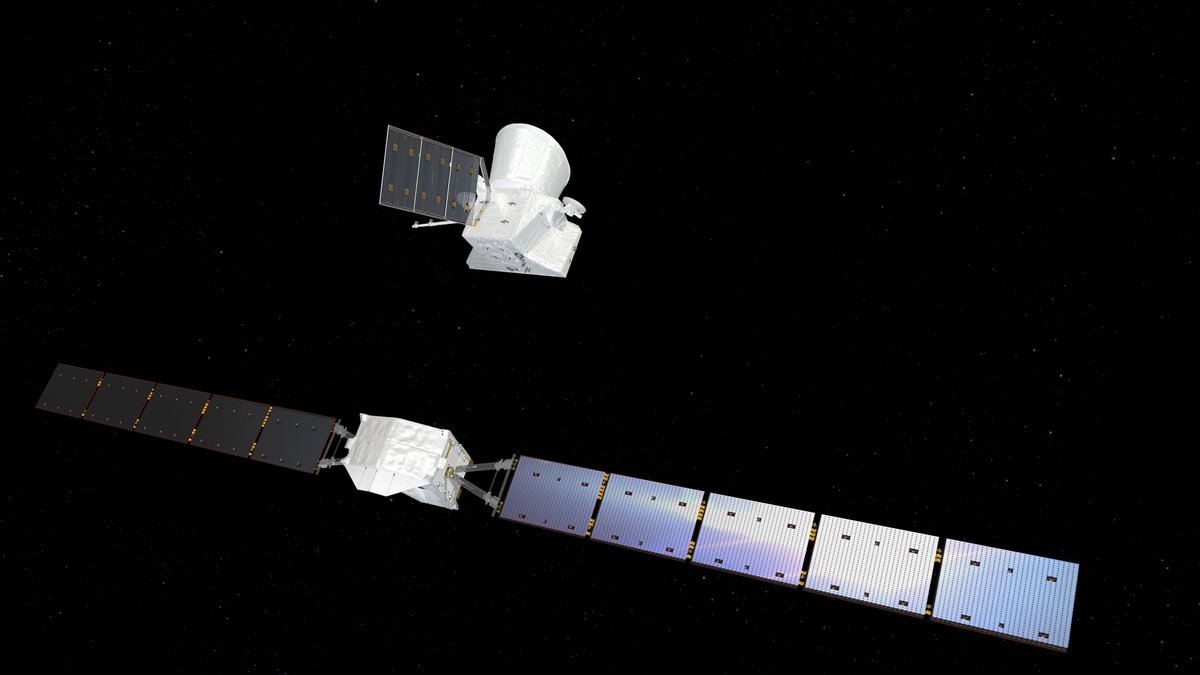
BepiColombo, the European-Japanese spacecraft, finally reached the final phase of its eight-year journey to Mercury after a critical maneuver on Thursday successfully deployed its two science orbiters.
The mission launched in October 2018, taking a long, looping route to reach the solar system’s innermost planet. Mercury’s extreme proximity to the Sun makes it a challenging target—strong gravitational pulls and intense solar radiation complicate navigation. BepiColombo has been using planetary flybys—once past Earth, twice at Venus, and six times at Mercury itself—to slow down and adjust its trajectory. The latest maneuver marked the start of the orbital insertion phase, positioning the spacecraft for long-term science operations around Mercury.
The two orbiters now separated—ESA’s Mercury Planetary Orbiter and JAXA’s Mercury Magnetospheric Orbiter—will study the planet’s surface, interior, and magnetic field. Mercury is a strange world: it has a massive iron core, a weak magnetic field, and a surface scarred by ancient volcanic activity. Scientists hope the mission will reveal whether Mercury hosts water ice in its polar craters and how it formed so close to the Sun. The orbiters are expected to begin full science operations in early 2026 after a series of braking maneuvers to enter orbit.
This mission is only the third to visit Mercury, following NASA’s Mariner 10 in the 1970s and MESSENGER in the 2010s. But BepiColombo carries far more advanced instruments, including cameras, spectrometers, and a laser altimeter. Its findings could rewrite our understanding of how rocky planets form and evolve—and even offer clues about planets in other solar systems. With the orbiters now in place, the real work begins: a three-year science mission that could redefine what we know about the smallest and closest planet to the Sun.
Read Full Story at Scientific American →