Rare two-headed turtle hatchling discovered on Cape Cod
Cape Cod is known for its lobsters and its growing great white shark population , but now the holiday hotspot has another extraordinary animal to showcase: A rare two-headed diamondback terrapin that…
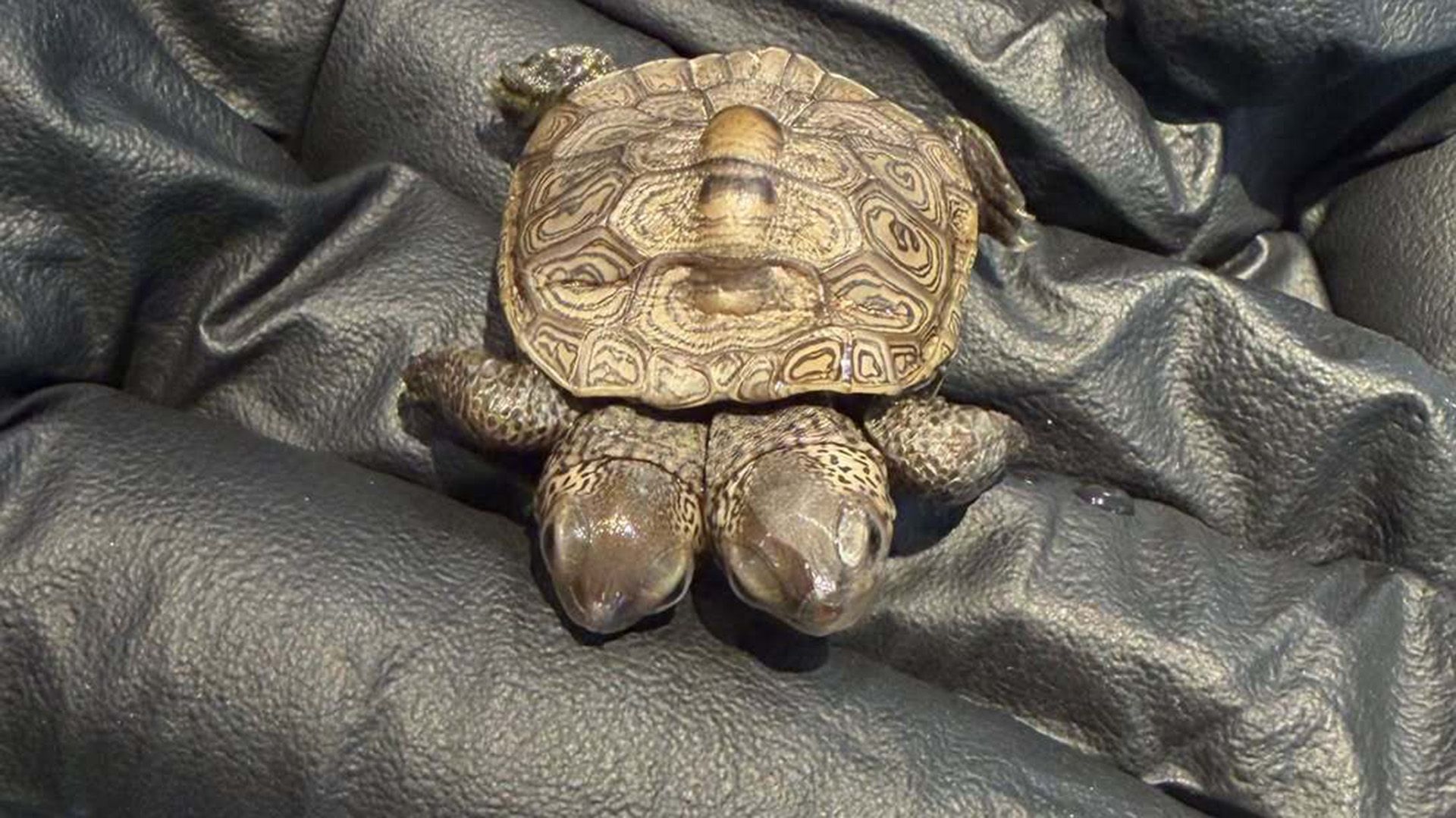
Cape Cod is known for its lobsters and its growing great white shark population , but now the holiday hotspot has another extraordinary animal to showcase: A rare two-headed diamondback terrapin that is surviving against the odds.
The baby turtle, which weighed just 0.18 ounces (5.2 grams), was brought to the Cape Wildlife Center in Barnstable, Massachusetts, on Sept. 17, according to a Facebook post from the wildlife center. It was originally found by representatives of the Mass Audubon Wellfleet Bay Wildlife Sanctuary at a protected nesting site in the town of Wellfleet.
The turtle's condition, known as bicephaly , is a rare developmental disorder that's typically caused by the incomplete splitting of a single embryo during the formation of identical twins. It results in conjoined twins that share one body but have two fully formed, independent heads.
Zak Mertz , CEO of New England Wildlife Centers, which includes the Cape Wildlife Center, said the recently discovered diamondback terrapin ( Malaclemys terrapin ) is an uncommon example of bicephaly in turtles. Both genetics and epigenetics — the study of how genes and environment can interact — are thought to play a role in the condition's development.
"Our understanding based on the available research is that bicephaly is caused by both genetic and epigenetic factors," Mertz told Live Science in an email.
"It may have to do with the relatively long lifespan of the turtles , their preference for returning to the same nesting sites, and a limited gene pool due to their conservation status," he said."It may also be influenced by environmental factors, such as the temperature, humidity during incubation, physical characteristics of the nesting sites, or potentially even things the parents are exposed to in the environment."
Having two heads is rare but not unprecedented. According to the center , this is the third bicephalic terrapin found in the area in the past five years, providing another opportunity to learn more about the animals. Other wild animals with bicephaly have been found in recent years, including a two-headed porpoise found off the coast of the Netherlands and a two-headed dolphin that was found on a Turkish beach.
Get the world’s most fascinating discoveries delivered straight to your inbox.
Read Full Story at Live Science →